Colonial exploitation in the Congo
Heart of DarknessColonial exploitation in the Congo is presented as an extractive order whose language of administration and improvement masks the seizure of land, coercive labor, and the pursuit of ivory. Marlow’s account follows that order from its declared justifications to its material consequences: people and supplies move through a network of stations, while productive work and even basic maintenance are repeatedly subordinated to commercial gain.
Imperial Rationale and Colonial Knowledge
Marlow distinguishes conquest from genuine colonization. The Europeans he describes take what they can by force for what can be acquired; in his assessment, the act has no moral value in itself. Its claimed redemption lies in an idea behind it, but the imperial ideal is compromised by the practices carried out in its name. This contrast sets the terms for the scenes that follow: the language of a civilizing purpose coexists with extraction and violence rather than restraining them.
The colonial presence also produces knowledge about the people sent to serve it. Before Marlow travels, a doctor asks permission to measure his head and records its dimensions. The doctor says he measures those departing for the territory in the interests of science, but never sees them again; he is interested in changes that occur internally and asks whether madness runs in Marlow’s family. The examination turns the colonial journey into an object of scientific observation, even as the doctor’s method offers no account of the conditions that might shape the changes he anticipates. His questions connect imperial confidence in classification with the personal risks of service abroad.
Labor and the Human Cost
At the first station, Marlow encounters six men compelled to carry earth in a chain gang. They are classified as criminals, while the work around them proceeds under the authority of colonial law. The scene exposes a gap between official labels and lived circumstances: the men are treated as subjects of punishment, although Marlow sees no meaningful relation between them and the destructive military force he has previously witnessed. The administration’s categories make their subjection appear lawful without explaining or relieving it.
Nearby, workers brought from the coast under time contracts have become ill in unfamiliar surroundings and with unfamiliar food. When they can no longer work efficiently, they are left to withdraw from the work site. Marlow finds them sick and starving in a grove used as a place of refuge and death. His account links their condition to the labor system rather than to an unexplained misfortune: recruitment, displacement, unsuitable provision, illness, and abandonment form a sequence in which workers are valued according to their usefulness. The station’s ongoing construction continues while these people are left outside its practical concern.
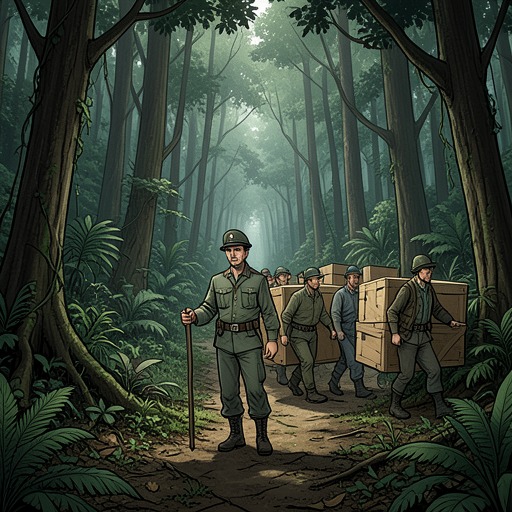
The same structure extends beyond the station. Marlow travels two hundred miles with a caravan of sixty men, each carrying a load of sixty pounds. The route passes through abandoned villages and deserted countryside; carriers sometimes die along the path, and the caravan’s repetitive cycle of marching and camping continues. A European road official claims responsibility for upkeep, but Marlow sees little evidence of a maintained road. The journey makes the distribution of burdens visible: Africans carry the goods and endure the risks, while European officials and traders occupy positions of authority or seek profit.
Stations, Trade, and Administrative Failure
The Company’s first station presents disorder alongside carefully maintained commercial routines. Goods—including cotton cloth, beads, and brass wire—move inland, while ivory returns in smaller quantities. Marlow spends ten days there and observes the contrast between the station’s general confusion and the chief accountant’s exact books and immaculate appearance. The accountant can preserve his own clerical standards amid disrepair, yet his correct entries record transactions within a wider system that depends on the movement of goods and the extraction of ivory.
At the Central Station, the machinery and organization of trade fail in ways that do not stop the search for profit. Marlow’s damaged steamer needs rivets; some are scattered nearby, but none reaches the place where repairs require them. Caravans continue to arrive with trade goods, while the small supply needed to return the boat to service remains unavailable. The delay makes the station’s priorities concrete: commercial cargo continues to travel through the network, but essential materials for work are poorly coordinated. The Company’s agents also spend time waiting, maneuvering against one another, and seeking appointments at trading posts where ivory can earn them percentages. Their rivalries concern access to profit more than the functioning of the enterprise as a whole.
The Eldorado Exploring Expedition brings the same priorities into sharper focus. It arrives in five installments with men, animals, tents, and supplies, but not the rivets Marlow needs. Its leader is the manager’s uncle, and Marlow understands the expedition’s aim as taking treasure from the land without a serious moral purpose or practical foresight. Meanwhile, the Company’s talk of philanthropy and government sits beside inactivity and private competition. The contrast is not simply between good intentions and bad execution: commercial desire organizes the station even when work is inefficient, supplies are misdirected, and the stated public purpose rings hollow.
Ivory, Kurtz, and the System’s Meaning
Ivory binds the scenes together as both commodity and object of fixation. At the stations, it is the return for manufactured goods and the prize sought by agents competing for profitable posts. At the Inner Station, Marlow finds heaps and stacks of it in and around Kurtz’s dwelling. The steamer is loaded with the stock, with additional tusks placed on deck. The volume of ivory makes the extraction tangible, while the labor and logistical failures surrounding its movement disclose who bears its costs and who claims its value.
Kurtz’s possessive attachment to ivory belongs to the same colonial order, though it takes a particularly concentrated form. He claims the ivory alongside his station, river, and other things around him, while the wilderness and the power he has acquired there have also taken hold of him. His career sharpens the contradiction between imperial ideals and practice: the International Society for the Suppression of Savage Customs had commissioned him to write a report, whose language presents European influence as an unbounded power for good. A later postscript calls for extermination, exposing the violence that the report’s benevolent rhetoric cannot contain. The contrast makes the civilizing claim look less like a restraint on exploitation than a language capable of concealing or licensing it.
When the manager assesses Kurtz, he focuses on the harm done to the Company, the district’s closure to trade, and the quantity of ivory that must be saved. His objection is to Kurtz’s unsound method, not to the extractive objective. Marlow’s account thus locates exploitation in more than individual cruelty: it is sustained by commercial incentives, administrative categories, logistics, and claims of improvement, and it persists even when officials criticize the way it is carried out. The wilderness surrounding the stations appears to Marlow as an enduring force beside a temporary European occupation; the trade network’s failures do not undo its central demand that people, labor, and territory be made available for extraction.